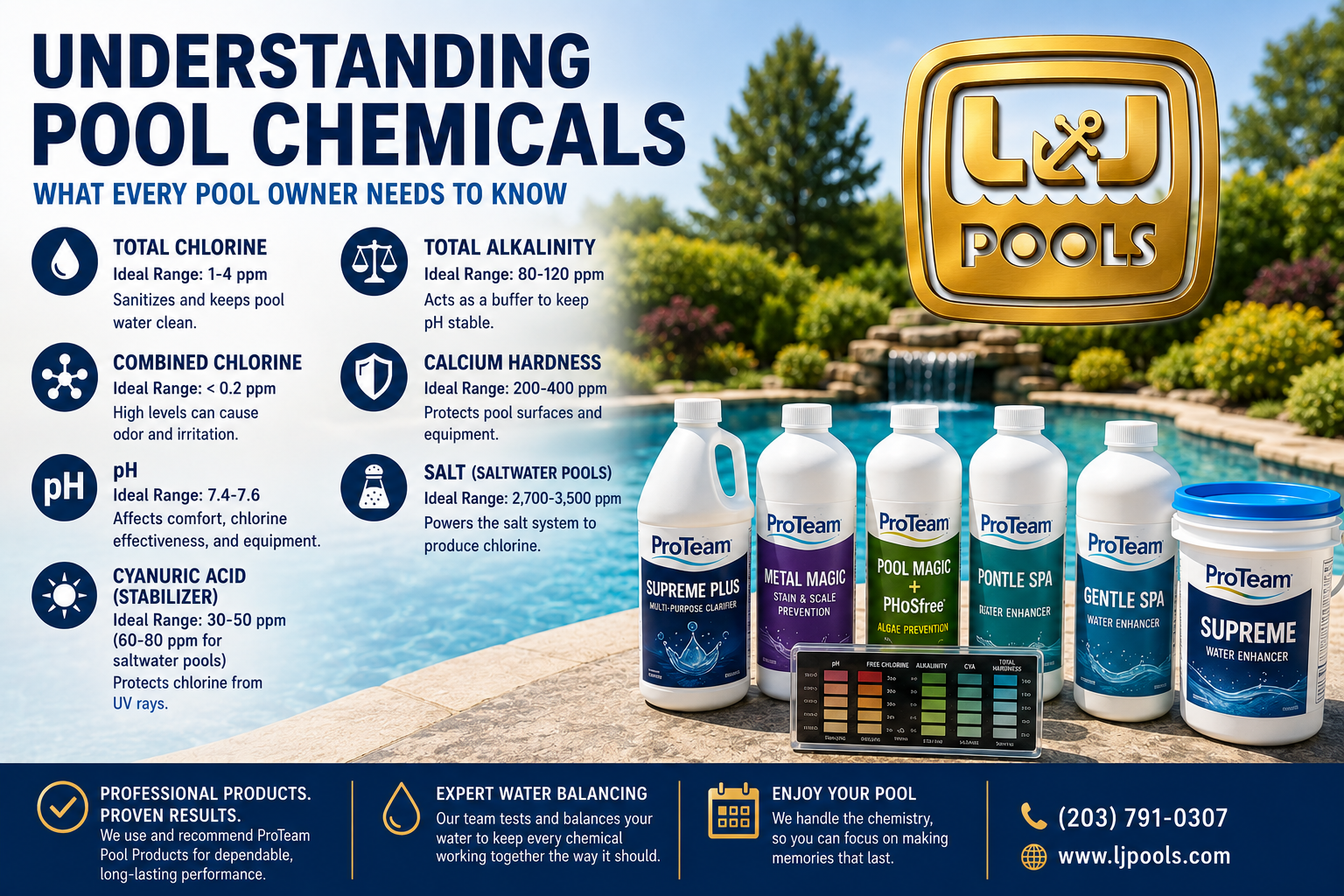
Understanding Pool Chemicals: What Every Pool Owner Needs to Know (and How ProTeam Products Can Help)
Keeping your swimming pool crystal clear takes more than simply adding chlorine. Proper water chemistry is the foundation of a healthy, safe, and beautiful pool. When your water is balanced, swimmers are more comfortable, equipment lasts longer, and you spend less time fighting algae and cloudy water.
At L&J Pools, we trust ProTeam Pool Products to help us maintain balanced, healthy water for our customers. ProTeam has built a reputation for manufacturing professional-grade pool chemicals that deliver reliable results for residential and commercial pools alike.
Here’s what every pool owner should know about the most important water chemistry levels.
Total Chlorine
Total chlorine measures the amount of chlorine in your pool, including both free chlorine (the chlorine actively sanitizing your water) and combined chlorine (chlorine that has already reacted with contaminants).
Ideal Range: 1–4 ppm
Maintaining proper total chlorine ensures your pool stays clean and safe for swimming. When chlorine levels begin to drop, ProTeam offers professional-strength sanitizers and shock treatments to help restore proper water quality.
Combined Chlorine
Combined chlorine forms when chlorine bonds with contaminants like sweat, sunscreen, body oils, leaves, and other organic material. Contrary to popular belief, the strong “chlorine smell” around a pool usually indicates too much combined chlorine—not too much chlorine.
High combined chlorine can cause:
- Strong chemical odors
- Eye and skin irritation
- Poor sanitation
- Cloudy water
Ideal Range: Less than 0.2 ppm
Using a quality shock treatment, such as those available through the ProTeam product line, helps eliminate combined chlorine and restores your pool’s sanitizing power.
pH
Your pool’s pH measures how acidic or basic the water is. It’s one of the most important numbers to monitor because it affects swimmer comfort and chlorine effectiveness.
Ideal Range: 7.4–7.6
When pH is too low:
- Water becomes corrosive
- Metal equipment can deteriorate
- Eyes and skin may become irritated
When pH is too high:
- Chlorine becomes less effective
- Water turns cloudy
- Scale can develop on surfaces and equipment
ProTeam offers pH increasers and reducers designed to make adjustments safely while maintaining balanced water chemistry.
Cyanuric Acid (Pool Stabilizer)
Cyanuric Acid (CYA), commonly called stabilizer or conditioner, protects chlorine from being destroyed by the sun’s UV rays.
Without enough stabilizer:
- Chlorine burns off quickly.
- You’ll spend more money replacing lost chlorine.
Too much stabilizer:
- Chlorine becomes less effective.
- Algae becomes more difficult to control.
Ideal Range:
- 30–50 ppm for traditional chlorine pools
- 60–80 ppm for most saltwater pools
ProTeam’s stabilizer products help maintain the proper balance so your chlorine works efficiently throughout the swimming season.
Total Alkalinity
Total alkalinity acts as a buffer that keeps your pH from changing too quickly.
Ideal Range: 80–120 ppm
Low alkalinity can cause:
- Rapid pH swings
- Corrosion
- Difficulty balancing water
High alkalinity may result in:
- Cloudy water
- Scaling
- High pH levels
Keeping alkalinity balanced first makes maintaining every other chemical much easier.
Calcium Hardness (Total Hardness)
Calcium hardness measures the amount of dissolved calcium in your water.
Ideal Range: 200–400 ppm
Low calcium hardness can:
- Damage plaster finishes
- Cause etching
- Corrode pool equipment
High calcium hardness may:
- Create scale buildup
- Cloud the water
- Reduce heater efficiency
ProTeam’s hardness management products can help maintain the proper calcium balance and protect your investment.
Salt (Saltwater Pools)
Saltwater pools rely on a salt chlorine generator to convert dissolved salt into chlorine.
Ideal Range: 2,700–3,500 ppm (always follow your manufacturer’s recommendations)
If salt levels are too low:
- Chlorine production decreases.
- Water sanitation suffers.
If salt levels are too high:
- Equipment may display error messages.
- Scale buildup may increase.
- Water may taste excessively salty.
Routine testing ensures your salt system continues operating efficiently.
Why L&J Pools Uses ProTeam
Not all pool chemicals are created equal. At L&J Pools, we recommend and use ProTeam Pool Products because they provide professional-grade solutions designed to improve water quality while protecting your pool and equipment.
Some of our favorite ProTeam products include:
- Supreme Plus – Helps improve water clarity while reducing chlorine demand.
- Metal Magic® – Helps prevent and remove metal staining and discoloration.
- Pool Magic® + PHOSfree® – Helps prevent algae growth by reducing phosphates naturally.
- Gentle Spa – Enhances water comfort by helping reduce eye and skin irritation.
- Supreme – A borate-based water enhancer that helps stabilize pH, improve water feel, increase sparkle, and reduce chlorine consumption.
Using the right products at the right time can make pool maintenance easier while reducing long-term chemical costs.
Let L&J Pools Keep Your Water Balanced
Testing and balancing pool chemistry can feel overwhelming, but you don’t have to do it alone.
At L&J Pools, we professionally test your water and use trusted ProTeam Pool Products to keep your pool clean, clear, and ready to enjoy all season long.
Whether you need weekly pool service, algae treatment, water testing, or help choosing the right ProTeam products, our experienced team is here to help.
Contact L&J Pools today to schedule professional pool service and experience the difference properly balanced water can make.
Comments are closed